

A winning stock: keep or sell?

A stock that has rewarded years of patience can become a difficult retirement decision. Selling part of it creates a visible tax cost. Keeping it preserves possible gains, but also leaves money you may soon need for spending dependent on one company.
The useful comparison is between the after-tax cost of reducing the holding and the company exposure that remains at each step. A gradual sale and a larger sale today can reach the same number of remaining shares while exposing the household to very different outcomes along the way.
A different job for the money
Consider Mark and Helen, a hypothetical couple approaching retirement with $2.5 million invested. They have $1.5 million in one publicly traded stock, held in a non-registered account, and $1 million in diversified investments. One company represents 60% of their invested assets.
They want more time for travel and family, and their investments will fund part of that spending. The stock helped build their savings, but its past success does not establish how much of their future income should depend on it. A sharp company decline could affect more than their investment statement. It could change the spending or retirement date those assets can support.
Reducing a successful holding can feel like abandoning a decision that worked. There is also the possibility of selling just before another rise. Mark and Helen can recognise those concerns while deciding how much company risk belongs in the next phase of their lives. Diversification can reduce dependence on that business, while leaving other investment risks to consider.
What a sale leaves available
Their stock has an adjusted cost base of $300,000. The illustration allows $3,000 in selling costs for the entire holding, allocated proportionally to the original shares sold. A partial sale uses only the cost base and selling costs attributable to those shares.
For these comparisons, tax is assumed to equal 25% of the total capital gain: a 50% inclusion assumption multiplied by an assumed 50% tax rate on the taxable half. This is an illustrative calculation, not an Ontario tax quote or a rate to apply to your own transaction. No capital losses are used.
Selling 60% of the original shares today produces $900,000. Subtracting $180,000 of cost base and $1,800 of selling costs gives a gain of $718,200. The assumed tax is $179,550, leaving $718,650 to reinvest after selling costs and tax. The cost base reduces the gain calculation; it is not another cash deduction from the proceeds.
The model reserves that tax from each sale before reinvestment. It does not imply tax is collected at the trade. An actual sale requires a calculation using the full return, including other income, usable losses, province, and year of sale. Those facts can change the amount available and whether spreading sales across years helps.
Three ways to keep exposure
Figure 1 sets out three choices: hold all the shares, sell 20% of the original holding now and again in years one and two, or sell 60% now. Both selling paths eventually retain 40% of the original shares. These percentages describe shares, not the stock’s weight in the total portfolio.
When are the original shares sold?
| Choice | Original shares sold | Kept at year two |
|---|---|---|
| Hold all | None | 100% |
| Sell gradually | 20% now; 20% year one; 20% year two | 40% |
| Sell 60% now | 60% now; no later sales | 40% |
Both sale paths retain 40% of the original shares, but reach that holding at different times.
A schedule changes exposure only as each sale happens. After the first gradual sale, 80% of the original shares remain subject to the company’s next move. The larger sale leaves 40% immediately. Future sale dates do not lock in today’s price.
First, suppose all investments stay flat. At the end of year two, after the last gradual sale, both selling paths hold about $2.32 million. Holding remains at $2.5 million. The difference reflects the assumed tax and selling costs triggered by the sales.
These are portfolio values, not fully after-tax spending amounts. Tax and costs are deducted on shares actually sold, but future tax on remaining assets is not deducted. Holding has deferred a sale tax rather than eliminated it. The comparison excludes dividends, withdrawals, taxes on reinvestment income, and compounding.
The cost of waiting
The company tests apply one price change immediately after today’s sale and before either later sale. The stock then stays at its new price, while existing diversified investments and all reinvested proceeds stay flat. Every outcome is measured at the end of year two. These are hypothetical conditions, not forecasts.
If the company falls 50%, holding leaves Mark and Helen with $1.75 million: $750,000 in company shares and their unchanged $1 million of diversified assets. The gradual path ends at about $1.79 million. Only its first sale occurred before the decline; the later sales receive the lower price, and the shares retained also lose value.
Selling 60% today leaves about $2.02 million under the same conditions. Figure 2 shows the effect of moving more money away from the company before this early decline. The larger sale incurred more assumed tax at the outset, but the resulting portfolio has less exposure to the company loss.
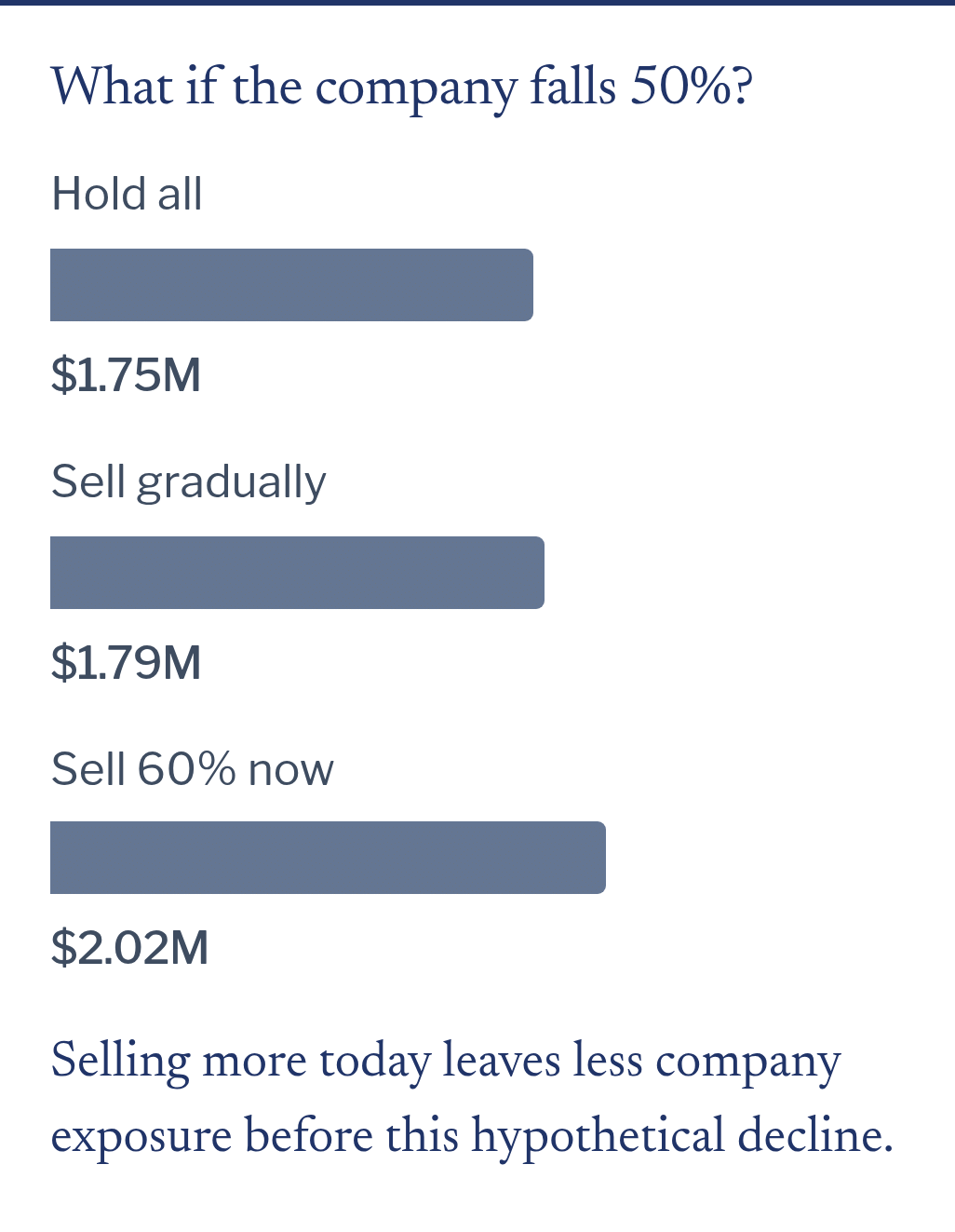
The gradual plan still reduced exposure. Its relatively small advantage over holding in this test does not mean it accomplished nothing. It means much of the original holding remained invested when the decline occurred. Whether that remaining risk is acceptable depends on the role these investments play in Mark and Helen’s retirement.
The opposite test deserves equal attention. If the stock instead rises 35% just after today’s sale, holding ends at about $3.03 million, selling gradually at $2.69 million, and selling 60% today at $2.53 million. Figure 3 shows the upside retained by each choice on the same scale as the decline comparison.
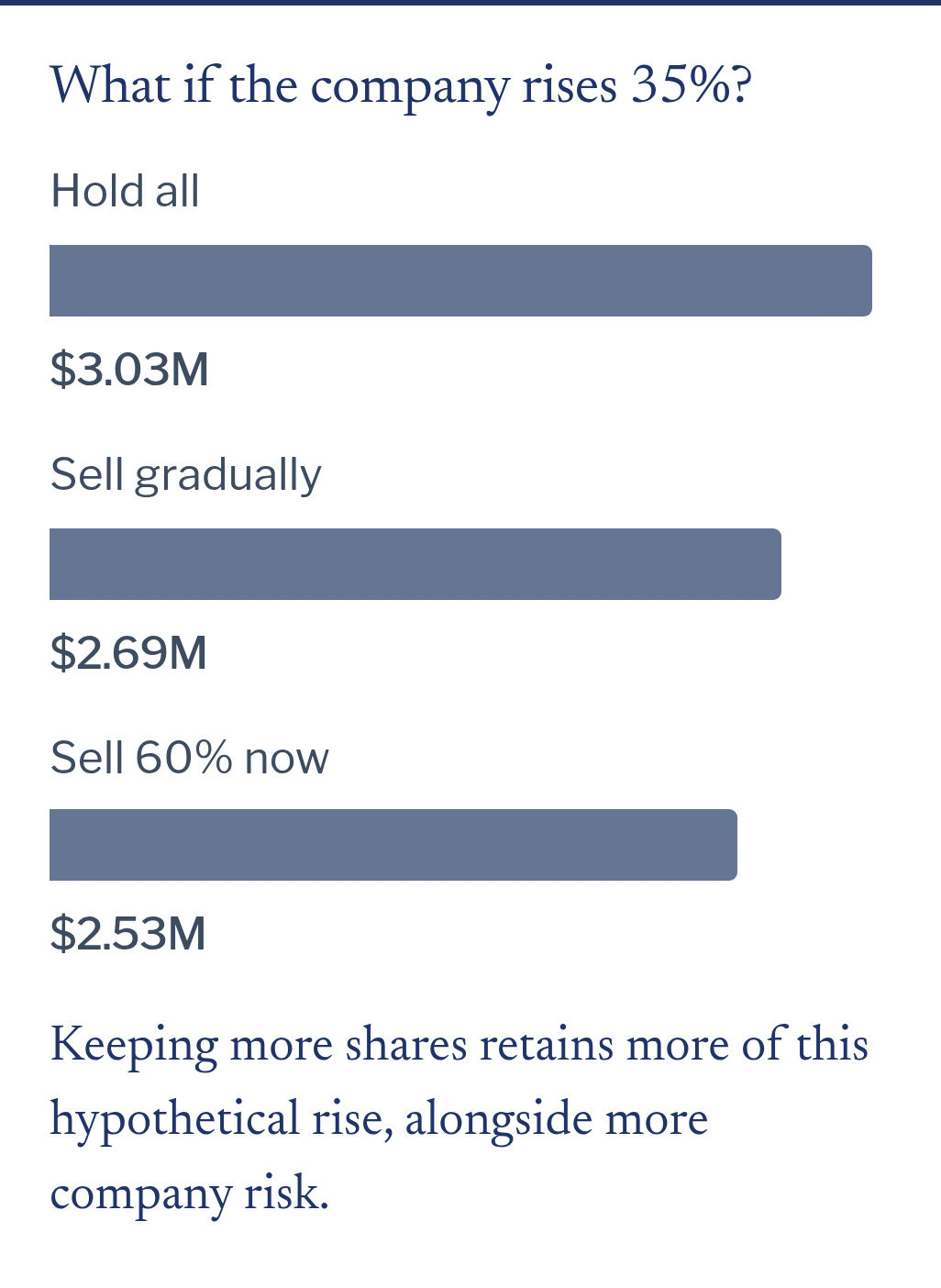
Holding keeps the most exposure to the company that rises. Gradual sales benefit from higher prices later, while the larger sale today gives up more of that increase. Reducing exposure limits participation in both directions. Neither test establishes a universally best sale percentage.
Market risk still matters
The diversified assets were flat in those tests to isolate the company effect. They need not be flat in a real downturn. In a separate illustration, the broader market falls 20% immediately after today’s sale. Company shares, existing diversified assets, and proceeds reinvested today all fall 20%.
Later gradual sales occur at the reduced stock price. Their proceeds are reinvested after the drop and stay flat thereafter. Holding ends at $2 million, gradual selling at about $1.86 million, and selling 60% today at about $1.85 million, again measured at the end of year two.
The small advantage for gradual selling comes from the timing of gains, assumed taxes, and selling costs. The unsold shares also fell 20%; that money did not escape the market decline. This particular result is not a benefit Mark and Helen can count on when choosing a schedule.
Diversification reduces reliance on one business. It does not make the whole portfolio immune to falling markets. The higher holding balance also remains subject to the earlier qualification: tax on assets still owned has not been deducted.
Bring it back to retirement
The decision starts with what the investments need to fund. For Mark and Helen, regular spending, travel, and family time give the numbers a purpose. A company loss that would require an unacceptable change in retirement timing or spending gives earlier risk reduction more weight, even when selling creates tax and gives up potential upside.
If the household can carry the remaining company exposure, a staged plan may be worth comparing using actual annual tax calculations. The constant tax assumption here does not test savings from different tax brackets across years. A gradual schedule also needs a clear reason for its dates and for any later changes. Repeatedly postponing a sale after either a rise or a fall can leave the intended reduction unfinished.
A useful planning discussion brings the cost base, proposed sales, actual tax estimate, and remaining company exposure together with retirement income needs. The aim is to compare choices the household could live with before knowing which market outcome will occur.
At Ferguson Financial Planning, we help business professionals, executives, and families connect retirement, investment, and tax choices, including the role of a concentrated stock holding. You can book an introductory conversation to discuss your situation and explore whether our approach is a good fit.